RHEINZINK® - Corrugated Profile
Technology
 |
|
|
|
|
|
System Description
- Façade cladding
- Cladding of small surfaces (eg. Balcony parapets)
RHEINZINK-corrugated profiles, just like panel systems, are suitable for buildings with a modern technological appearance such as commercial or industrial buildings. For cladding small surface areas, such as balcony parapets, they offer an easy to install, durable design option. They are frequently used in conjunction with other types of cladding.
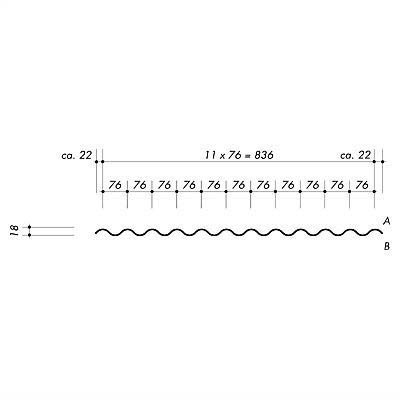
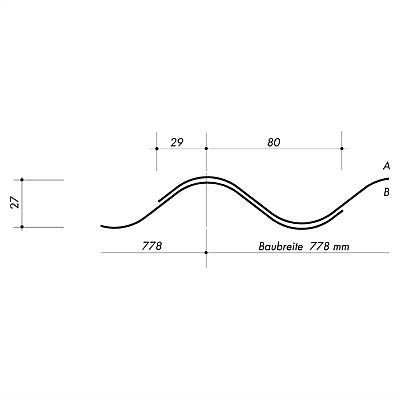
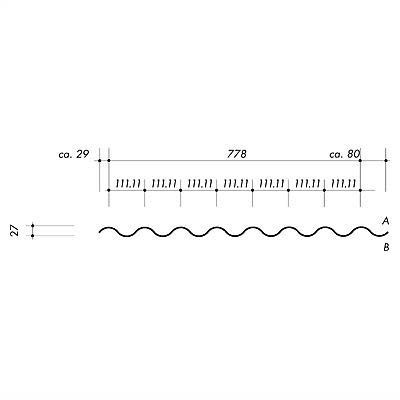
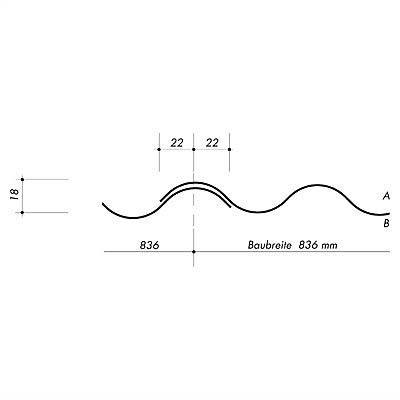
The geometry of the corrugated profile is sinus-wave shaped. There are two cross-sections available.
W 18 / 76 - 836
W 27 / 111 - 778
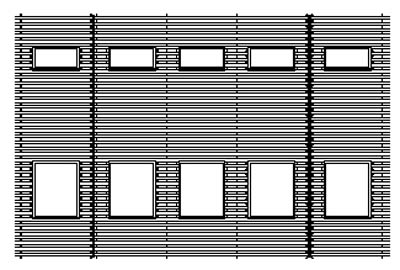
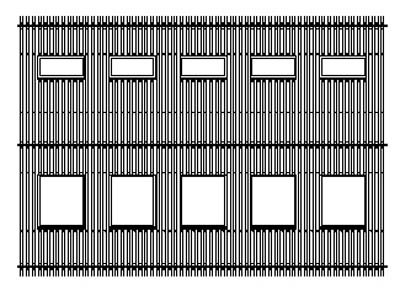
Corrugated profiles can be installed horizontally or vertically. This allows for a multitude of design possibilities.
Furthermore, convex or concave rounded areas can be achieved. However, the RHEINZINK-Department of Application Technology should be consulted during the planning stage.
RHEINZINK-corrugated profiles are visibly fastened with suitable screws or rivets in the bead hollow. For horizonal application, installation takes place from bottom to top.
|
| |
|
|
|
|
|
 |
|
|
|
|
|
| |
|
|
|
|
|
 |
|
|
|
|
|
| |
|
|
|
|
|
 |
|
|
|
|
|
Surface Quality
- RHEINZINK-"preweathered-pro blue-grey"
- As a rule, RHEINZINK-profile systems are available in the RHEINZINK-"preweathered-pro blue-grey" surface quality.
Surface Protection
- Application of foil sheeting
In order to protect the surface during production and transportation, and to provide protection against negative influences during the construction phase, facade systems are delivered with foil sheeting. The strippable film is a one-sided self-adhesive protective sheet, which is applied at the factory. It should be removed directly after installation at the end of each working day.
Note:
The corrugated profiles can be individually cut-to-size for each project. This is based on a bill of materials completed by the craftsman. An exact measurement onsite is essential nonetheless.
All details such as window fittings, corners, attic or base moulding, etc. are to be agreed upon with the architect in the context of design planning prior to installation. Layered construction, a detail concept and the grid of the facade must be determined by the architect/designer during the planning stage.
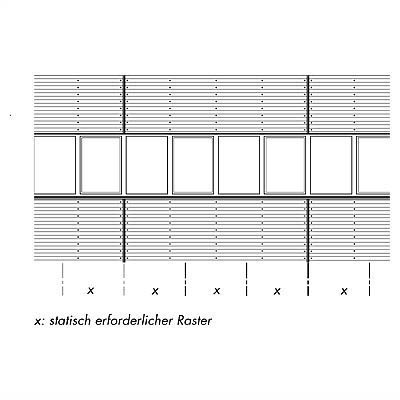
Visible fastening is a decisive detail in the design and the appearance of the façade. A correctly planned and cleanly executed installation of the substructure is therefore imperative. Optical requirements could mean it is necessary to construct more rows of substructure than statically required.
Fastening
- Directly to the substructure using self-adhesive screws or rivets.
Fastening is done directly to the substructure by means of self-tapping screws with a sealing washer or rivet. Fastening is visible in the corrugation hollow.
As a substructure we recommend two- or multipart metal bracket systems made of non-corrosive materials. The required distance of the substructure depends on expected wind suction loads, the selected static system (one-, two- or multiple field support), and the fasteners.
The allowable spacing for fixing, can be taken from the measurement tables.
Fasteners
- Mainly self-tapping screws or blind rivets
Self-tapping screws are particularly suitable for fastening corrugated profiles to the metal substructure e.g. drill fastener SX 3/4 - L12 - A12 5,5 x L, manufacturers SFS Stadler GmbH. & Co. KG. With its flat, round head and almost invisible sub-head bolt, it fits unobtrusively and harmoniously into the general picture. There is the option of covering these bolts with an ex-works powder coated head,(RAL 7001 similar to blue-grey). Additional details are available from the manufacturer.
Installation is done in one operation using an appropriate insertion tool; no pre-drilling is required.
Choice of bolts is determined by different criteria
- Static requirements/function
- Location of operation
- Thicknesses of material for the parts/components to be joined
Blind rivets (mainly pop cup rivets) are also suitable. The disadvantage is that additional pre-drilling is required.
The use of non-corrosive materials is recommended for application within the façade area. Approval of fasteners should be obtained from building or site supervisors.
Joint Design

Thermal expansion of the profiles is accommodated by separation - by using expansion pieces. Statically joined fields may not be longer than 4000 mm. The substructure must be formed separately for each field of the façade in the area of the expansion joint.
- Overlap joint (horizontal, vertical and diagonal installation)
The corrugated profiles can overlap horizontally. The length of overlap is ≥ 100 mm.
- Pilaster strip profile (horizontally installed)
The vertical joint is emphasised with a pilaster strip, e.g. as a sword section. It should be protruding (10 to 15 mm), in order to prevent one from looking into the profile.
- Cornice section (vertically installed)
The horizontal joint can be emphasised with profiles of varying widths. Care should be taken not to interrupt or cut off the rear ventilation area.
Other ideas for joint design can be found at:
Standard details/Installation instructions